
2725 Park Dr, Suite 1, Clearwater, FL 33763
Precision Restorations That Go Beyond What a Filling Can Do
When a tooth has been damaged by decay or fracture to a degree that goes beyond what a filling can reliably address — but does not yet warrant a full crown — a porcelain inlay or onlay is often the most conservative, effective, and long-lasting solution available.
At Boulevard Dental in Clearwater, Dr. Jason Kopakin uses custom-crafted porcelain inlays and onlays to restore back teeth with a level of precision, strength, and natural aesthetics that direct fillings simply cannot match. These restorations are fabricated from high-quality dental porcelain that closely mimics the appearance of natural tooth enamel — making them virtually invisible once placed — and are bonded directly to the tooth for a secure, durable fit designed to last for many years.
If you have a tooth with significant decay, a failing large filling, or a crack that has compromised the chewing surface, an inlay or onlay may be the ideal way to restore full function while preserving as much of your natural tooth structure as possible.
Schedule Your Inlay or Onlay Consultation
What Are Inlays and Onlays
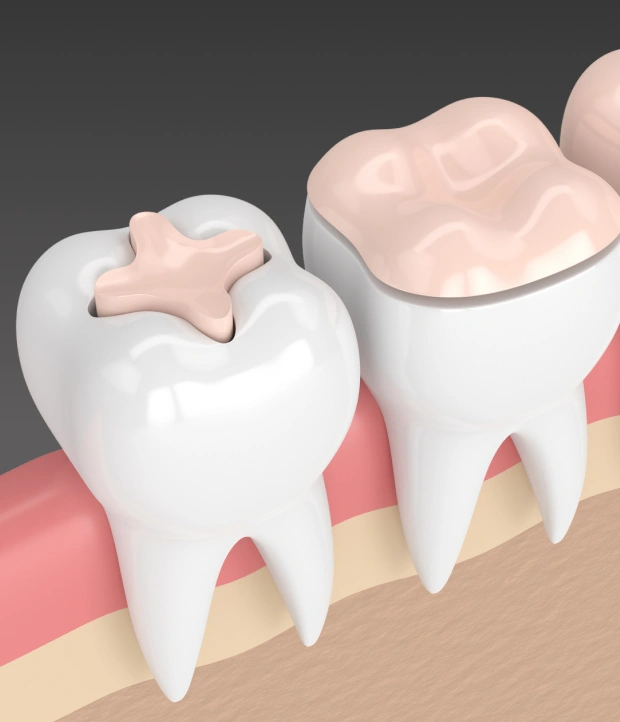
Inlays and onlays are indirect restorations — meaning they are custom-fabricated outside the mouth, and then bonded permanently into or onto the tooth. This sets them apart from direct fillings, which are placed and shaped chairside in a single appointment. Both inlays and onlays are used to restore the chewing surfaces of the back teeth — molars and premolars — and the distinction between the two comes down to how much of the tooth surface they cover:
- Inlays fit within the cusps — the raised points — of the tooth's chewing surface, restoring the central portion of the tooth without extending over the cusps themselves. An inlay is used when the damage or decay is confined to the area between the cusps and the tooth's outer walls remain intact and structurally sound.
- Onlays extend beyond the cusps to cover one or more of the outer points of the tooth in addition to the central chewing surface. An onlay is used when the damage is more extensive — involving one or more cusps — but the remaining tooth structure is still healthy enough that a full crown is not yet necessary. Onlays are sometimes referred to as partial crowns for this reason.
Both restorations are bonded to the tooth using strong dental adhesives, becoming a stable, integrated part of the tooth that restores full chewing function and protects the remaining natural structure.
When Are Inlays and Onlays Recommended
Our Clearwater dentist may recommend an inlay or onlay in the following situations:
-
Large or Failing Fillings
When an existing filling has become too large, has cracked, or has begun to fail, replacing it with an inlay or onlay provides a more durable and longer-lasting restoration than simply placing another large filling in the same area. -
Extensive Tooth Decay
When decay has progressed beyond the scope of what a standard filling can reliably restore — but has not yet compromised enough of the tooth to require a full crown — an inlay or onlay offers a precise, conservative alternative. -
Cracked or Fractured Cusps
A crack or fracture involving one or more cusps of a back tooth can be effectively addressed with an onlay, which covers and protects the damaged cusp without the need for full-crown preparation. -
Structural Weakness
When a back tooth has been weakened by decay, previous restorations, or fracture to the point where a standard filling would not provide adequate long-term support, an inlay or onlay reinforces the tooth and distributes chewing forces more effectively. -
Cosmetic Improvement of Back Teeth
For patients with old silver amalgam fillings they wish to replace for aesthetic reasons, porcelain inlays and onlays offer a natural-looking, metal-free alternative that blends seamlessly with the surrounding tooth.
The Inlay & Onlay Process at Boulevard Dental Clearwater
Getting an inlay or onlay at our Clearwater office typically involves two appointments:
-
Appointment 1 – Preparation & Impressions
Your Clearwater dentist begins by administering local anesthesia to ensure complete comfort. The decayed or damaged tooth structure is carefully removed and the area is cleaned and prepared to receive the restoration. A precise impression or digital scan of the prepared tooth is taken and sent to our dental lab, where your custom inlay or onlay is fabricated from high-quality porcelain matched to your tooth's natural shade. A temporary restoration is placed to protect the prepared tooth while your permanent restoration is being made — typically a turnaround of one to two weeks. -
Appointment 2 – Bonding & Placement
When your inlay or onlay is ready, you return to our Clearwater office for permanent placement. The temporary restoration is removed and the fit, shape, and color of the new restoration are carefully verified before bonding. The tooth surface is prepared for bonding, and the inlay or onlay is permanently cemented into place using a strong dental adhesive. Your bite is checked and any final adjustments are made before you leave. Once bonded, the restoration is fully functional immediately.
How Long Do Inlays and Onlays Last
With proper care, porcelain inlays and onlays are among the most durable restorations in dentistry — typically lasting 10 to 30 years. Their longevity is significantly greater than large direct fillings, and many patients find that their inlay or onlay outlasts expectations by a wide margin.
Factors that contribute to the longevity of your restoration include maintaining excellent oral hygiene at home, attending regular professional cleanings and exams at our Clearwater office, avoiding habits that place excessive stress on the restoration, and wearing a night guard if bruxism is a concern.
Our Clearwater team evaluates the condition of existing restorations — including inlays and onlays — at every routine appointment to ensure they remain fully intact and properly sealed.
Ready to Restore Your Tooth With a Precision Porcelain Restoration in Clearwater
If you have a tooth with significant decay, a large failing filling, or a cracked cusp that needs attention, a porcelain inlay or onlay from Boulevard Dental Clearwater may be the most conservative and long-lasting solution available. Our Clearwater team will evaluate your tooth thoroughly, explain your options clearly, and help you make the decision that is right for your oral health and your long-term goals.
We offer morning and afternoon appointments Monday through Friday. Our office is conveniently located in north-central Clearwater near SR 580 and US 19 in Pinellas County.
Book My Inlay or Onlay Consultation